Five Small Experiments to Tame Your Catchall Drawer
Question: Can a single drawer go from chaotic catchall to quietly useful without a full weekend project? That’s the small, practical question I set out to answer. The approach is a short series of experiments — each one takes 10–30 minutes and builds a single skill that helps the drawer stay helpful over time.
What you need
- A clear tabletop or space next to the drawer
- A timer (phone works fine)
- A few small containers — boxes, lids, muffin tin, or little bins
- A towel or paper for a quick surface
Experiment 1 — The Empty-and-Sort Check (10–15 minutes)
Goal: Get a reality check without committing to decisions. This is a fast inventory that makes the problem obvious and gives a baseline.
- Set a 10-minute timer.
- Pull everything out of the drawer onto your towel or table.
- Group items into broad piles: keep in drawer, move elsewhere, toss/recycle, undecided.
- Return only the clearly ‘keep in drawer’ pile to the drawer for now.
Review: How full was the ‘keep’ pile? If it nearly fills the drawer, you have a capacity problem and need to be stricter in the next experiments.
Experiment 2 — Create Purpose Zones (15–20 minutes)
Goal: Give the drawer 2–4 mini-purposes so items have a logical place.
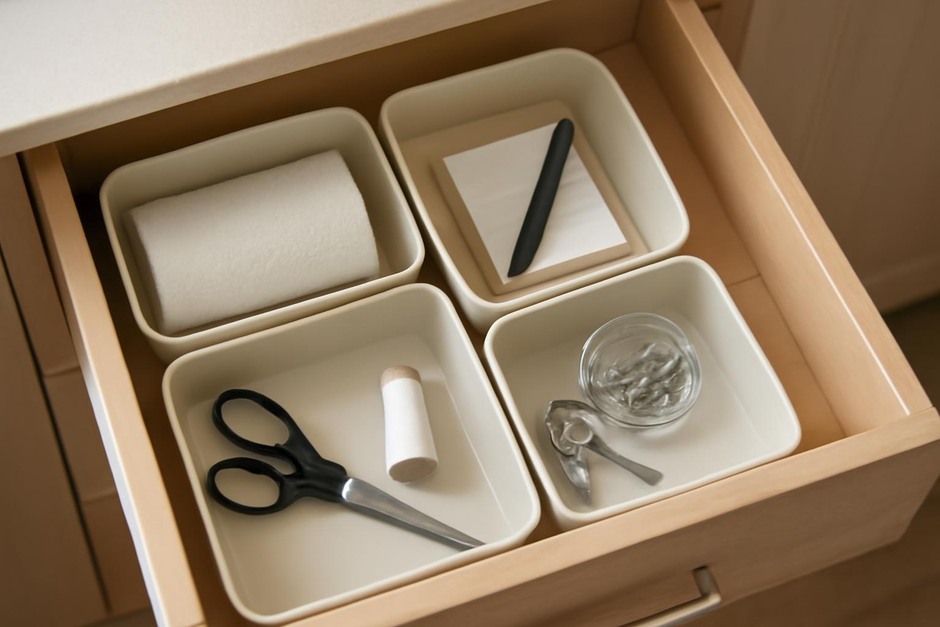
- Using the remaining items, decide 2–4 simple zones — for example: chargers & cables, tools & tape, pens & paper, everyday odds-and-ends.
- Place items into those zones on the table.
- Put a container or visual divider for each zone in the drawer. Use whatever you have; matching bins aren’t required.
Review: Do the zones make sense with how you use the drawer? If you reach for things and they’re in a weird zone, rename or swap zones to match behavior.
Experiment 3 — The One-in/One-out Rule (7–10 minutes)
Goal: Prevent future accumulation by pairing new items with an outgoing one.
- Declare a simple rule: when you add a new item to the drawer, remove one existing item that serves a similar purpose.
- Practice immediately: take two items from the drawer that are rarely used and put one into a donation box and one into a short-term storage box (for the ‘maybe’ category).
Review: This rule is a behavioral scaffold — it helps you say no to silent buildup without dramatic purges.
Experiment 4 — The Two-Minute Tidy Habit (2 minutes daily)
Goal: Build a tiny maintenance routine so the drawer never needs a big reset again.
- Choose a trigger: after making coffee, before bed, or when you put dishes away.
- Set a 2-minute timer. Open the drawer, check that items are in their zones, and return any stray pieces to their place.
Review: Track this for a week. Two minutes is short enough that the habit sticks, but frequent checks keep disorder from compounding.
Experiment 5 — A Monthly Quick Audit (15 minutes)
Goal: Spot duplicates, expired items, or forgotten things without anxiety.
- Once a month, take everything out and lay it on the table.
- Ask three quick questions about each item: Have I used this in the last 3 months? Does it belong in this drawer? Is there a better home for it?
- Move items accordingly: donate, relocate, or keep.
Review: The monthly audit keeps the drawer aligned with changing needs — new cables, seasonal tools, or hobby supplies that come and go.
Process notes and troubleshooting
• If the drawer still fills up: reduce the number of items allowed in each zone. Be intentionally lean; fewer duplicates mean clearer choices.
• If things feel fussy: simplify containers. A simple folded paper divider or pair of small boxes often works better than trying to match styles.
• If you forget the two-minute habit: tie it to an existing routine (for example, check the drawer while your kettle boils).
Final review
After trying these experiments for a month, you should have three gains: a clear visual map of what belongs in the drawer, a simple maintenance habit that prevents backslide, and a lightweight decision rule for new items.
Small experiments are forgiving. If one step doesn’t fit your life, tweak it and try again. The goal isn’t perfection — it’s a drawer that behaves like a little tool: available, predictable, and quietly useful.